Function performance profiling: timing and memory metrics
To start profiling functions performance you’ll only need #[hotpath::main] and #[hotpath::measure] macros:
#[hotpath::measure]
fn sync_function(sleep: u64) {
    std::thread::sleep(Duration::from_nanos(sleep));
}

#[hotpath::measure]
async fn async_function(sleep: u64) {
    tokio::time::sleep(Duration::from_nanos(sleep)).await;
}

// When using with tokio, place the #[tokio::main] first
#[tokio::main]
#[hotpath::main]
async fn main() {
    for i in 0..100 {
        // Measured functions will automatically send metrics
        sync_function(i);
        async_function(i * 2).await;

        // Measure code blocks with static labels
        hotpath::measure_block!("custom_block", {
            std::thread::sleep(Duration::from_nanos(i * 3))
        });
    }
}
When the hotpath feature is disabled, all macros are noop and have zero compile or runtime overhead.
Run your program with a hotpath feature:
cargo run --features=hotpath
Output:
[hotpath] Performance summary from basic::main (Total time: 122.13ms):
+-----------------------+-------+---------+---------+----------+---------+
| Function              | Calls | Avg     | P99     | Total    | % Total |
+-----------------------+-------+---------+---------+----------+---------+
| basic::async_function | 100   | 1.16ms  | 1.20ms  | 116.03ms | 95.01%  |
+-----------------------+-------+---------+---------+----------+---------+
| custom_block          | 100   | 17.09µs | 39.55µs | 1.71ms   | 1.40%   |
+-----------------------+-------+---------+---------+----------+---------+
| basic::sync_function  | 100   | 16.99µs | 35.42µs | 1.70ms   | 1.39%   |
+-----------------------+-------+---------+---------+----------+---------+
#[hotpath::main] macro
Attribute macro that initializes the background measurement processing when applied. Supports parameters:
percentiles = [50, 95, 99]- Custom percentiles to display, sorted and deduplicated, at most 10 (defaults to[95])format = "json"- Output format"table","json","json-pretty","none"(defaults totable)limit = 20- Maximum number of functions to display (default:15,0= show all)output_path = "report.json"- Filesystem path for profiling reports. If not set, the report is written tostdout. Can be overridden byHOTPATH_OUTPUT_PATH; on Unix, set that env var to/dev/stdoutor/dev/stderrto redirect to the standard streams.report = "functions-timing,channels"- Report sections spec:all,auto, an exact comma-separated list of section names, or auto with exclusions like"auto,-threads". Defaults to auto - function and thread sections plus every instrumented section with data (overridden byHOTPATH_REPORTenv var)
#[hotpath::measure] macro
An attribute macro that instruments functions to send timing/memory measurements to the background processor. Parameters:
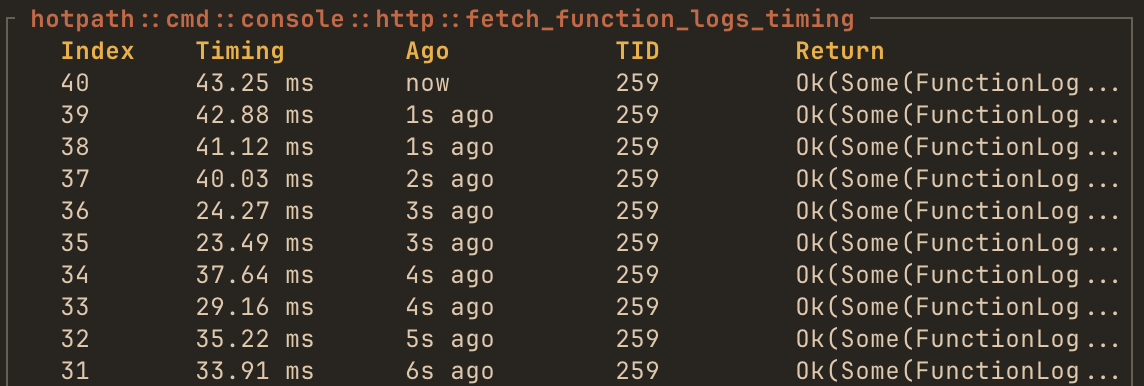
log = true- logs the result value when the function returns (requiresstd::fmt::Debugon return type)label = "name"- replaces the full reported identifier (instead ofmodule_path::<fn_name>).impl_type = "Type"- inserts the enclosing type segment so the registered name becomesmodule_path::<Type>::<fn_name>. Use this for bare#[hotpath::measure]on a method inside animplnot covered bymeasure_all. Required for correct CPU sampling attribution underhotpath-cpu(see CPU profiling), since the demangled symbol contains the type segment.future = true- additionally tracks the async function as a future: poll counts, poll durations, and pending/ready/cancelled state transitions. Only valid onasync fn.
Example:
#[hotpath::measure(log = true)]
fn compute() -> i32 {
    // The result value will be logged in TUI console
    42
}

#[hotpath::measure(label = "db_query")]
fn fetch_user(id: u64) { /* ... */ }

struct Worker;
impl Worker {
    #[hotpath::measure(impl_type = "Worker")]
    fn run(&self) { /* ... */ }
}
Async functions and future = true
#[hotpath::measure] on an async fn records its wall-clock time and allocations in the functions report, but nothing about how the future itself behaves. Add future = true to also register it in the futures section, which shows poll counts, average poll duration, and whether calls completed or were cancelled:
#[hotpath::measure(future = true)]
async fn fetch_data() -> Vec<u8> {
    // Reported under both functions and futures, keyed by the function path
    vec![1, 2, 3]
}
This is the recommended way to monitor async functions: one attribute covers timing, allocations and future lifecycle. The future! and #[future_fn] macros from the async data flow page are for ad-hoc future expressions.
#[hotpath::measure_all] macro
An attribute macro that applies #[measure] to all functions in a mod or impl block. Useful for bulk instrumentation without annotating each function individually. Can be used on:
- Inline module declarations - Instruments all functions within the module
- Impl blocks - Instruments all methods in the implementation
Example:
// Measure all methods in an impl block
#[hotpath::measure_all]
impl Calculator {
    fn add(&self, a: u64, b: u64) -> u64 { a + b }
    fn multiply(&self, a: u64, b: u64) -> u64 { a * b }
    async fn async_compute(&self) -> u64 { /* ... */ }
}

// Measure all functions in a module
#[hotpath::measure_all]
mod math_operations {
    pub fn complex_calculation(x: f64) -> f64 { /* ... */ }
    pub async fn fetch_data() -> Vec<u8> { /* ... */ }
}
Note: Once Rust stabilizes
#![feature(proc_macro_hygiene)]and#![feature(custom_inner_attributes)], it will be possible to use#![measure_all]as an inner attribute directly inside module files (e.g., at the top ofmath_operations.rs) to automatically instrument all functions in that module.
Note (CPU sampling): On inherent impl blocks (
impl Type { ... }),measure_allauto-injects the type segment so methods are registered asmodule_path::<Type>::<method>- this matches the demangled symbol used byhotpath-cpuattribution. Trait impls (impl Trait for Type) are still instrumented for timing/allocation, but their demangled symbols use the<Type as Trait>::methodform, so CPU sampling will not attribute samples to those methods.
#[hotpath::skip] macro
A marker attribute that excludes specific functions from instrumentation when used within a module or impl block annotated with #[measure_all]. The function executes normally but doesn’t send measurements to the profiling system.
Example:
#[hotpath::measure_all]
mod operations {
    pub fn important_function() { /* ... */ } // Measured

    #[hotpath::skip]
    pub fn not_so_important_function() { /* ... */ } // NOT measured
}
hotpath::measure_block! macro
Macro that measures the execution time of a code block with a static string label.
#[hotpath::main]
fn main() {
    for i in 0..100 {
        // Measure code blocks with static labels
        hotpath::measure_block!("custom_block", {
            std::thread::sleep(Duration::from_nanos(i * 3))
        });
    }
}
If hotpath feature is disabled, the code inside block will still execute.
Memory and allocations profiling
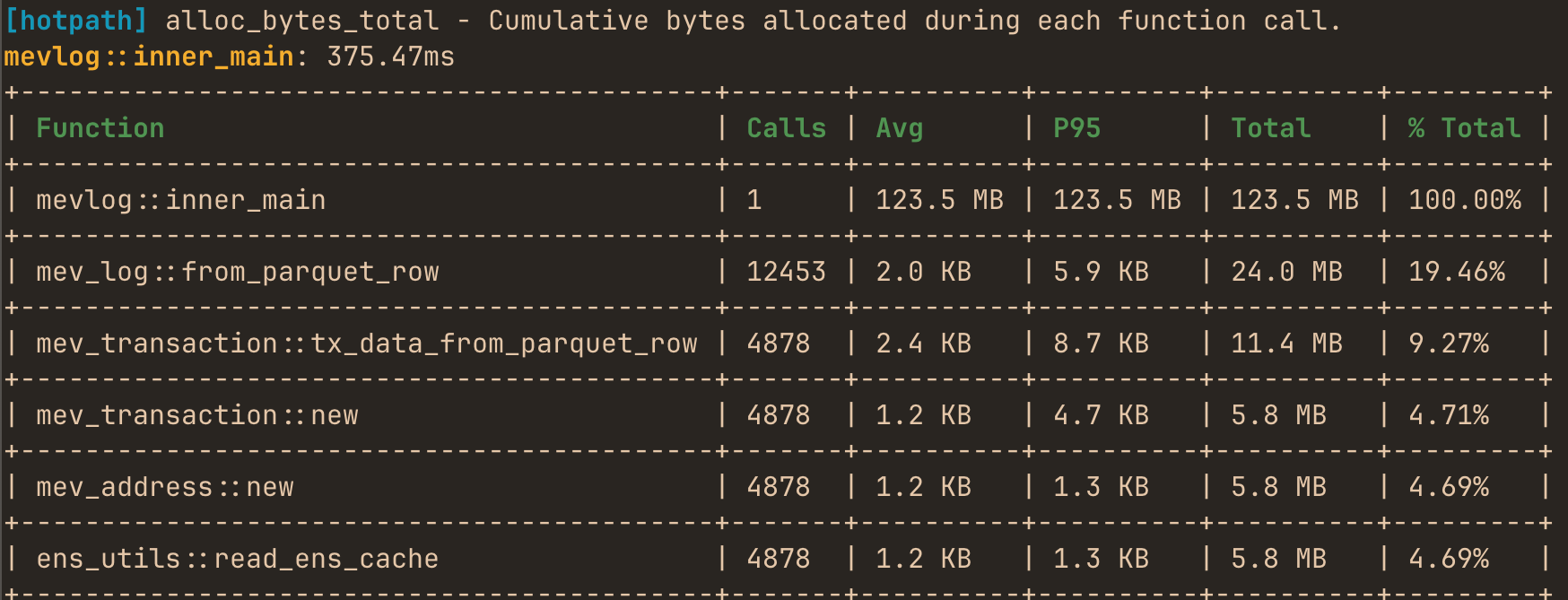
In addition to time-based profiling, hotpath can track memory allocations. This feature uses a custom global allocator from allocation-counter crate to intercept all memory allocations and provides detailed statistics about memory usage per function.
Run your program with the allocation tracking feature to print a similar report:
cargo run --features='hotpath,hotpath-alloc'
Memory profiling modes
By default, allocation tracking is exclusive, meaning each function only reports allocations made directly at its own level, excluding nested instrumented calls.
To switch to cumulative mode (where a function’s allocation count includes all allocations from nested instrumented calls), set HOTPATH_ALLOC_CUMULATIVE=true. Note that cumulative mode produces invalid results for recursive functions because the same allocations are counted multiple times as they propagate up through each recursive frame.
Custom inner allocator
The tracking allocator forwards every allocation to an inner allocator, std::alloc::System by default. To profile a program that uses a different allocator, pass it via the allocator parameter of #[hotpath::main]. For example, with tikv-jemallocator:
[dependencies]
tikv-jemallocator = "0.6"
#[hotpath::measure]
fn alloc_work() {
    let buf = vec![0u8; 4096];
    std::hint::black_box(&buf);
}

#[hotpath::main(allocator = tikv_jemallocator::Jemalloc)]
fn main() {
    for _ in 0..100 {
        alloc_work();
    }
}
cargo run --features='hotpath,hotpath-alloc'
The report now shows per-function allocation stats measured through jemalloc: every allocation is counted by the tracking wrapper, then served by jemalloc instead of the system allocator.
The path must name a unit struct implementing GlobalAlloc (like MiMalloc from mimalloc or Jemalloc from tikv-jemallocator). When the hotpath-alloc feature is disabled, the parameter is ignored and no allocator is installed, so combine it with your own #[global_allocator] behind a feature gate if the program should also use the allocator in normal builds.
All four GlobalAlloc methods (alloc, dealloc, alloc_zeroed, realloc) forward to the inner allocator’s native implementations, so wrapping does not change its zeroed-allocation or reallocation behavior. A successful realloc is tracked as a deallocation of the old size plus an allocation of the new size.
Allocation tracking with HotpathGuardBuilder
The #[hotpath::main] macro installs the tracking allocator for you. The HotpathGuardBuilder API does not do that (a #[global_allocator] must be declared as a static item), so when initializing hotpath programmatically you must declare it yourself:
#[global_allocator]
static GLOBAL: hotpath::CountingAllocator = hotpath::CountingAllocator::new();

fn main() {
    let _hotpath = hotpath::HotpathGuardBuilder::new("main").build();
    // ...
}
Use hotpath::CountingAllocator::with(...) to wrap a custom inner allocator:
#[global_allocator]
static GLOBAL: hotpath::CountingAllocator<tikv_jemallocator::Jemalloc> =
    hotpath::CountingAllocator::with(tikv_jemallocator::Jemalloc);
The declaration needs no feature gating: CountingAllocator is exported in every feature configuration, and when hotpath-alloc (or hotpath itself) is disabled it is a pure pass-through to the inner allocator with no tracking overhead. This also makes it the simplest way to keep a custom allocator active in normal builds: the program always runs on jemalloc, and allocation tracking switches on only with hotpath-alloc.
Don’t combine a manual declaration with #[hotpath::main] - under hotpath-alloc the macro installs its own #[global_allocator], and two declarations fail to compile. Use the allocator parameter with the macro, and the manual declaration with the builder.