Channels monitoring
hotpath::channel! macro
This macro wraps channel creation to automatically track usage statistics and data flow:
use tokio::sync::mpsc;

#[tokio::main]
#[hotpath::main]
async fn main() {
    // Create and instrument a channel in one step
    let (tx, mut rx) = hotpath::channel!(mpsc::channel::<String>(100));

    // Use the channel exactly as before
    tx.send("Hello".to_string()).await.unwrap();
    let msg = rx.recv().await.unwrap();
}
std::sync channels can be instrumented by default. Enable tokio, futures, or crossbeam features for Tokio, futures-rs, and crossbeam channels, respectively.
Supported channel types:
tokio::sync::mpsc::channeltokio::sync::mpsc::unbounded_channeltokio::sync::oneshot::channelfutures_channel::mpsc::channelfutures_channel::mpsc::unboundedfutures_channel::oneshot::channelcrossbeam_channel::boundedcrossbeam_channel::unbounded
Optional config
// Custom label for easier identification in TUI
let (tx, rx) = hotpath::channel!(mpsc::channel::<String>(100), label = "worker_queue");

// Enable message logging (requires std::fmt::Debug trait on message type)
let (tx, rx) = hotpath::channel!(mpsc::channel::<String>(100), log = true);
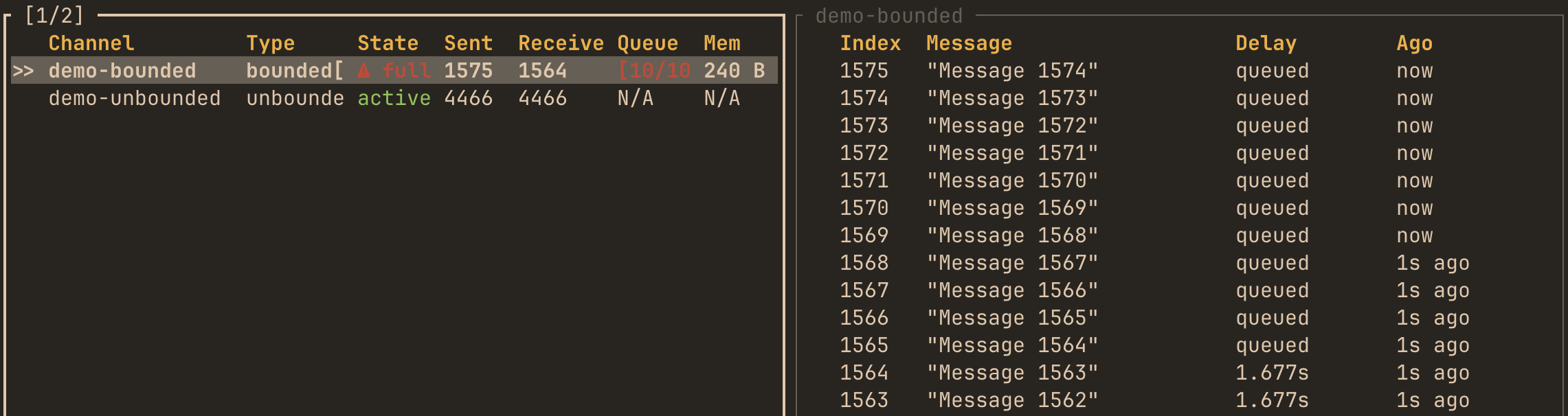
Label channels to display them on top of the list. By passing log = true TUI will display messages that a channel received.
Capacity parameter requirement
For futures::channel::mpsc bounded channels, you must specify the capacity parameter because their API doesn’t expose the capacity after creation:
use futures_channel::mpsc;

// futures bounded channel - MUST specify capacity
let (tx, rx) = hotpath::channel!(mpsc::channel::<String>(10), capacity = 10);
Tokio and crossbeam channels don’t require this parameter because their capacity is accessible from the channel handles.
A note on accuracy
hotpath instruments channels by using a proxy on the receive side with the capacity of 1. Messages flow directly into your original channel, then through a proxy before reaching the consumer. This design adds 1 slot of extra buffering for bounded channels.
Please note that enabling monitoring can subtly affect channel behavior in some cases. For example, using try_send may behave slightly differently since the proxy adds 1 slot of extra capacity. Also some wrappers currently not propagate info about receiver getting dropped.
I’m actively improving the library, so any feedback, issues, bug reports are appreciated.